When a project, hotel or distribution network needs a large quantity of liquid soap dispensers, appearance is not the only buying criterion. Quality testing must prove that the body, pump, connections and raw materials remain reliable in everyday use and bulk transport. This guide reviews the key tests you should request when selecting a soap dispenser manufacturer.
These tests are most useful when combined with the criteria in our guide to choosing a soap dispenser manufacturer.
1. Body and reservoir leak test
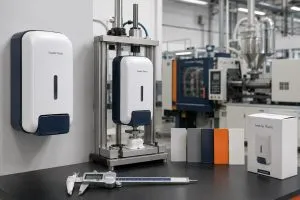
For a leak test, fill the reservoir with the test liquid and leave it in several positions for a defined period. The reservoir joint, thread, washer and area beneath the pump must remain completely dry. For a bulk order, ask the manufacturer to document its sampling method, test duration and acceptance limit. Testing several samples from every production batch separates a one-off defect from a repeatable problem.
2. Pump durability and consistency
The pump should complete a specified number of consecutive presses without sticking, incomplete return or a noticeable drop in flow. The output per press should also be as consistent as possible, so users do not waste liquid or press repeatedly to obtain a sufficient dose.
For viscous liquids, add the guidance on choosing a pump for thick liquids to your checklist.
3. Raw-material compatibility with the liquid
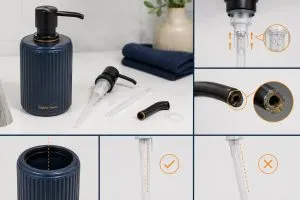
Soap, gel and disinfectant formulas can affect the body and internal parts. A professional manufacturer should specify the material of liquid-contact components, the supported viscosity range and the result of its compatibility test. Stable, controlled raw materials reduce early discoloration, cracking and brittleness.
4. Dimensional and visual quality control
Record dimensional tolerances, component alignment, colour consistency, plating or print quality and the absence of flash in the quality checklist. For multi-colour orders, keep an approved colour sample as the reference to minimise differences between production batches.
For a project order, coordinate the details of custom manufacturing and OEM before prototyping.
5. Installation and packaging test
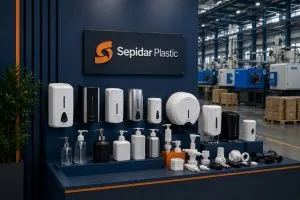
A wall-mounted dispenser must be installed on a standard surface and support the weight of a full reservoir. Screws, anchors and the back plate should not make the product loose or tilted. Packaging also needs protection for the pump and body corners, a stable carton layout and a controlled drop test, especially when the products are shipped for export.
Short checklist for wholesale buyers
- Request the leak-test report and sampling method.
- Ask for the pump test-cycle count and average dose.
- Confirm the materials of liquid-contact parts and viscosity limits.
- Approve the colour sample and final packaging sample before mass production.
- Write spare-parts terms and discrepancy handling into the quotation.
Frequently asked questions
Is one sample test enough for a wholesale order?
No. The first sample is useful for design approval, but several random samples from the production batch should also be checked.
What matters most for viscous liquids?
Consistent flow, a suitable internal path and pump compatibility with the liquid viscosity become more important.
If you need help choosing a model, sampling or custom production, see Sepidar custom manufacturing and OEM services and the Sepidar product catalogue. For a project purchase, you can also read our wholesale wall-mounted soap dispenser buying guide.